China’s top CNC machines are becoming practical gateways to Industry 4.0. They cut metal, but their deeper value lies in connected production. Sensors track spindle vibration, tool wear, temperature, and cycle time. Software then turns these signals into decisions. That shift explains what role cnc machines play in industry 4.0.
Professor Klaus Schwab, founder of the World Economic Forum and a leading Industry 4.0 thinker, wrote, “The fourth industrial revolution will create a world where virtual and physical systems of manufacturing cooperate with each other in a flexible way at the global level.” Chinese CNC manufacturers are moving toward this cooperation through industrial Ethernet, cloud platforms, digital twins, and machine-learning maintenance systems. A modern five-axis machine can inspect a turbine component, upload quality data, and adjust future operations. Less waste. Faster feedback.
Yet the picture is not perfect. Connectivity does not automatically create intelligent manufacturing. A factory may purchase advanced equipment but lack skilled programmers, clean data, or secure networks. That weakness deserves attention. Operators still need judgment when a cutting tool produces an unusual sound. Engineers must verify software recommendations before changing tolerances or feed rates. China’s strongest CNC machines can support flexible, traceable, and energy-aware production, but their results depend on people, process discipline, and reliable integration. This article examines their role through real manufacturing functions, including automation, predictive maintenance, customization, and human-machine collaboration. It also considers where expectations exceed current capabilities. Industry 4.0 is not simply a machine upgrade. It is a continuous learning process.
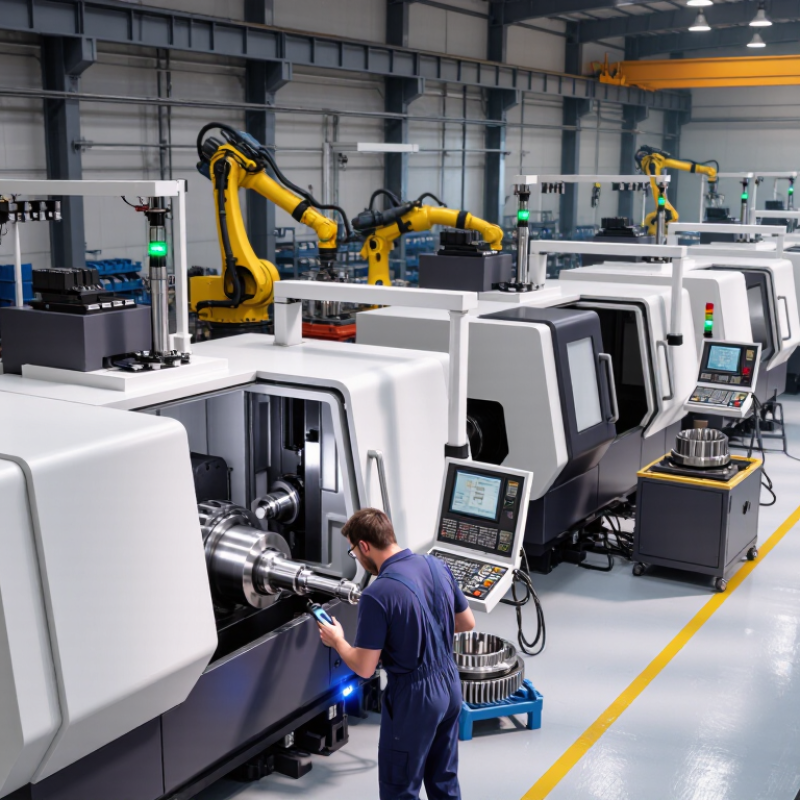
China’s top CNC machines are increasingly defined by Industry 4.0 functions, not cutting speed alone. A capable system connects machine sensors, production software, and quality data. It can monitor spindle load, vibration, temperature, and tool wear during machining. Operators can view alarms through a central dashboard or secure industrial network. This improves traceability for complex parts, especially in aerospace, medical, and automotive production. In practical evaluations, reliable data exchange often matters more than impressive specifications. No machine is fully smart.
A strong CNC platform should support automatic tool compensation, remote diagnostics, and condition-based maintenance. Integrated inspection can compare finished dimensions with digital models and record deviations immediately. Some systems also create digital twins for testing programs before material reaches the worktable. However, connectivity does not guarantee accuracy. Poor sensor calibration, incomplete training, or weak data protection can reduce real value. This is where careful engineering judgment remains essential.
Tips: Check communication standards before purchasing. Request sample production data. Test repeatability under real workloads. Ask how software updates affect existing programs. Leave room for human review, because automated recommendations can still be wrong.
China’s manufacturing sector represents 31.6% of global manufacturing value added, according to the United Nations Industrial Development Organization. This figure gives China unusual weight in Industry 4.0 development. It also creates pressure to improve quality, energy use, and production flexibility.
Top CNC machines support this shift through connected sensors, automatic tool adjustment, and real-time production data. A factory can monitor spindle temperature, cutting vibration, and tool wear before defects spread. Digital work instructions also help operators manage complex parts with fewer manual checks. In practice, this shortens setup time and improves consistency across repeated batches. The result is valuable, but not automatic.
Many workshops still operate mixed fleets of old and new equipment. Their software may not communicate smoothly. That gap can weaken the benefits of smart manufacturing. Skilled technicians remain essential for calibration, process judgment, and unexpected material changes. I have found that stable data collection often matters more than adding advanced features. A machine may offer impressive connectivity, yet poor maintenance can undermine every dashboard. The 31.6% figure should therefore be read carefully. It measures manufacturing value added, not universal factory intelligence. China’s scale is powerful, but Industry 4.0 progress depends on implementation, workforce training, and honest performance checks. Small errors reveal much.
China’s advanced CNC machines are becoming connected production assets, not isolated cutting tools. Five-axis control reduces repositioning, improves access to complex surfaces, and can shorten setup time. In a typical aerospace fixture, the spindle moves around the workpiece while probes verify alignment. This is practical intelligence.
Industrial Internet of Things connectivity links CNC controllers, sensors, tooling, and quality systems. Operators can monitor spindle load, vibration, temperature, and cycle time from one dashboard. Deloitte’s 2024 Smart Manufacturing and Operations Survey found that 86% of manufacturing executives expect smart manufacturing to strengthen competitiveness within three years. Yet connectivity alone does not create value. Poor sensor calibration can produce confident but wrong decisions.
Digital twins add a virtual production layer. Engineers can test toolpaths, thermal behavior, and maintenance scenarios before changing the physical line. The Digital Twin Consortium identifies interoperability, data governance, and lifecycle management as essential requirements. AI then detects unusual vibration patterns, predicts tool wear, and recommends parameter adjustments. The operator should still approve critical changes.
That human check matters. A 2023 International Federation of Robotics report recorded 541,302 industrial robot installations worldwide in 2023, showing how quickly automated production is expanding. CNC systems must therefore exchange reliable data with robots, inspection equipment, and enterprise platforms. China’s strongest machines will not be defined by speed alone. Their real advantage will depend on traceable data, stable five-axis accuracy, and useful intelligence at the shop-floor level. Some factories remain too optimistic. A digital twin can look precise while missing real cutting forces.
China’s CNC machines are becoming practical nodes in Industry 4.0 factories. They connect machining, inspection, scheduling, and material handling through shared production data. This connection matters as automation expands rapidly.
The International Federation of Robotics reported 276,288 industrial robots installed in China during 2023. That represented about 51% of global installations. China also held approximately 1.75 million operational industrial robots, according to World Robotics 2024. CNC systems help these robots perform repeatable tasks, including loading parts, changing tools, and checking dimensions. In a typical workshop, a robot places a metal blank into a CNC machine. Sensors then record cycle time, vibration, and tool wear. Managers can adjust production before defects multiply. The process is powerful, but not perfect. Poor data still creates poor decisions.
Tips: Start with one measurable workflow, such as unmanned loading during night shifts. Track uptime, scrap rate, energy use, and operator interventions. Keep human checks for unusual sounds, unstable cutting, and unexpected surface marks. A smart factory should not become a blind factory.
The International Federation of Robotics also reported that robot density in China reached about 470 units per 10,000 manufacturing employees in 2023. This figure signals stronger automation capability, yet it does not guarantee productivity. Skilled workers still configure processes, interpret data, and correct hidden weaknesses. CNC investment works best when machine connectivity, workforce training, and maintenance planning develop together.
| Data Dimension | China / Industry 4.0 Indicator | How CNC Machines Contribute | Reference |
|---|---|---|---|
| Industrial robot installations | 276,288 units installed in China in 2023 | Shows the scale of automation available for machine tending, loading and unloading, inspection, and material handling around CNC production cells. | International Federation of Robotics, World Robotics 2024 |
| Share of global robot installations | Approximately 51% of global industrial robot installations in 2023 | Creates a large installed base for integrating CNC equipment with robots, sensors, production software, and automated logistics. | International Federation of Robotics, World Robotics 2024 |
| Operational robot stock | Approximately 1.76 million industrial robots operating in China at the end of 2023 | A large installed automation base supports scalable CNC cell designs and improves the feasibility of unmanned or lightly attended production. | International Federation of Robotics, World Robotics 2024 |
| Robot density | 470 industrial robots per 10,000 manufacturing employees in 2023 | Indicates a high level of factory automation potential for repetitive CNC operations and digitally coordinated production cells. | International Federation of Robotics, World Robotics 2024 |
| Digital machine connectivity | Real-time collection of machine status, alarms, cycle times, tool data, and production counts | Connected CNC machines turn shop-floor events into usable production data for monitoring, scheduling, traceability, and maintenance analysis. | Industry 4.0 manufacturing architecture; ISO 23247 digital-twin framework |
| Closed-loop quality control | Measurement results can be used to adjust machining parameters and compensate for process variation | CNC equipment can combine probing, inspection, tool monitoring, and statistical process data to reduce dimensional drift and rework. | ISO 9001 quality-management principles; smart manufacturing practice |
| Predictive maintenance | Uses vibration, temperature, spindle load, axis load, lubrication, and alarm-history data | Data-driven maintenance helps identify abnormal machine conditions before they cause unplanned downtime. | ISO 13374 condition-monitoring data-processing framework |
| Flexible production | Digital programs, recipes, tooling records, and work orders can be managed centrally | Supports quick changeovers, small-batch production, mixed-model manufacturing, and consistent process documentation. | Industry 4.0 cyber-physical production principles |
| Human–machine collaboration | Operators remain responsible for setup, process validation, exception handling, and quality decisions | CNC automation reduces repetitive work while retaining human oversight for complex decisions and process improvement. | ISO 10218 and ISO/TS 15066 principles for robot-system safety |
| Business impact | Improved utilization, repeatability, traceability, response speed, and production visibility | CNC machines become connected production assets rather than isolated tools, forming a core layer of smart manufacturing systems. | Industry 4.0 manufacturing-system practices |
What Role Do China Top CNC Machines Play in Industry 4.0?
Advanced CNC machines can support Industry 4.0 through connected production, precise machining, and real-time process data. Their value depends less on machine speed than on deployment discipline. A modern workshop may connect a machining center, inspection station, and production dashboard. Yet operators still need practical training. They must understand tool wear, data alarms, offsets, and safe recovery procedures. Digital skills cannot replace machining experience.
Interoperability is another difficult point. Different controllers, sensors, and factory systems may use inconsistent data formats. A small mismatch can delay production or create unreliable reports. Cybersecurity also needs daily attention. Separate networks, controlled access, software updates, and tested backups can reduce operational risk. One overlooked maintenance laptop may weaken the whole system. Our first return-on-investment estimate was too optimistic. We counted labor savings, but ignored integration time, training hours, and rejected parts during adjustment.
Tips: Begin with one measurable process, such as reducing setup time by 15 percent. Map every data connection before installation. Train operators beside the machine, not only in a classroom. Track downtime, scrap, energy use, and maintenance response for several months. Review the results honestly. A connected machine is not automatically a smart factory. Sometimes a simple sensor and a clear work instruction deliver more value than a complicated platform.
Skills and interoperability typically create the greatest deployment friction because modern CNC systems require trained personnel, consistent data models, and integration with MES, ERP, and IIoT platforms. Cybersecurity and uncertain return on investment remain major concerns when connecting machines across the factory network.
China accounts for 31.6% of global manufacturing value added. This shows scale, not universal factory intelligence.
They collect spindle temperature, cutting vibration, and tool wear data. Managers can respond before defects spread.
Yes, they guide operators through complex parts and reduce repeated manual checks. Setup time may decrease.
Mixed fleets often use incompatible software. Data gaps then limit scheduling, inspection, and maintenance decisions.
About 276,288 industrial robots were installed in China during 2023. That represented roughly 51% of global installations.
A robot can load a metal blank into a CNC machine. Sensors record cycle time, vibration, and tool wear.
No. Robot density reached about 470 units per 10,000 manufacturing employees, but productivity still depends on skills and maintenance.
Start with one workflow, such as night-shift loading. Track uptime, scrap rate, energy use, and operator interventions.
Yes, technicians handle calibration, process judgment, and unexpected material changes. Machines still miss subtle problems.
They may reveal unstable cutting, tool wear, or incorrect settings. Small errors matter. Not every dashboard tells the truth.
China’s top CNC machines are becoming essential building blocks of Industry 4.0 by combining precision machining with connected, data-driven production. Their role goes beyond cutting and shaping materials: five-axis control supports complex manufacturing, while Industrial Internet of Things connectivity enables real-time monitoring, predictive maintenance, and production optimization. Digital twins can simulate processes before implementation, and artificial intelligence can help detect errors, improve scheduling, and enhance quality. This development is particularly significant because China represents 31.6% of global manufacturing value added, creating a large environment for smart CNC adoption.
The question of what role cnc machines play in industry 4.0 is also closely linked to automation. In 2023, China installed 276,288 industrial robots, demonstrating the growing connection between CNC equipment, robotics, and integrated production systems. However, successful deployment requires more than advanced hardware. Manufacturers must address shortages of technical skills, interoperability between systems, cybersecurity risks, and uncertain returns on investment. With proper planning, smart CNC machines can improve flexibility, productivity, traceability, and long-term competitiveness across modern manufacturing.

Cora CNC